
What does trust mean?
Trust means downstream teams can reasonably rely on healthcare data because quality, governance, and evidence are built into the data flow.
In healthcare, trust cannot depend on hope or downstream cleanup. Interstella defines trust through quality and data governance, supported by operational evidence that makes downstream reliance more practical.

The trust model is intentionally practical. Data is more trustworthy when it is usable, defensible, and supported by visible evidence of how it was handled.
Trust means downstream teams can reasonably rely on healthcare data because quality, governance, and evidence are built into the data flow.
Quality improves usability, but governance is needed to make data handling accountable, inspectable, and defensible for operational or regulated environments.
DTRF, the Data Trust and Refinery Framework, is Interstella's way of organizing how quality and governance create trust and downstream value.
AI systems depend on reliable inputs. Interstella's model helps reduce risk by making healthcare data more structured, governed, and easier to inspect before use.
Interstella treats trust as the result of two complementary disciplines. Quality improves usability. Data governance improves defensibility. Together, they support downstream reliance.
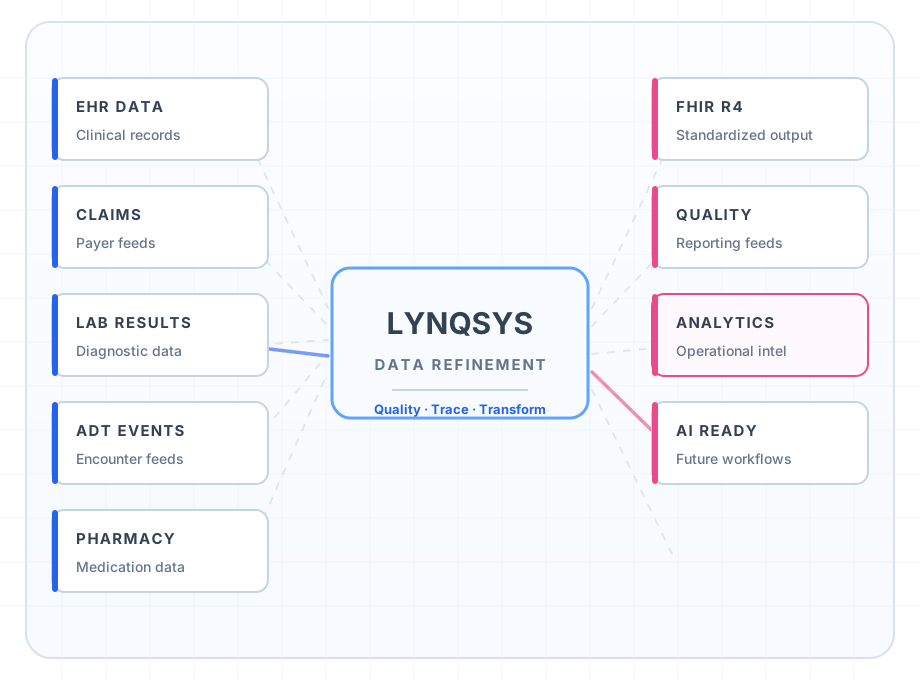
Quality helps data become more usable through clearer validation, more consistent handling, and better downstream readiness.
Data governance makes handling more inspectable and accountable, supporting defensible downstream use.
Real-time logging of handling activity, prompt context, and resulting outputs for review-ready inspection.
Human-in-the-loop controls help teams review or intervene when workflows become sensitive or high impact.
Tracking for model drift, reliability, and evidence quality so trust does not stop at initial deployment.
Policy-driven permissions support safer access to sensitive data, workflows, and higher-risk operational actions.
Trust is not created by data movement alone, and it is not proven by claims of quality in isolation. Organizations need evidence that shows how data was handled and why published outputs can be used with more confidence.
That evidence supports better operational decisions, clearer accountability, and a stronger basis for downstream reliance.
It gives teams something concrete to evaluate when data moves into exchange, reporting, analytics, and AI workflows.
Interstella connects the foundation of trust to visible evidence, then to the value organizations need from downstream data.
DTRF (Data Trust and Refinery Framework) is Interstella's framework for organizing how quality and data governance support trust. It helps structure the way trust is evaluated, supported, and made visible through operational evidence.
In practice, DTRF connects the trust model to platform behavior so organizations can better understand how data becomes more usable and more defensible over time.
DTRF organizes trust evaluation across five dimensions, validated by 593 structured rules applied at the data element level. It gives Interstella a repeatable framework for connecting quality, governance, evidence, and downstream value.
DTRF applies 593 validation rules across five trust dimensions to assess and evidence healthcare data before it reaches downstream use. Each dimension represents a distinct type of operational evidence.
Evidence that data conforms to expected structure, format, and applicable standards. Conformance checks are applied before data moves downstream.
Evidence that required data elements are present. Gaps are surfaced and recorded rather than silently passed through.
Evidence that data is internally consistent across fields, encounters, and related records. Conflicts are identified and handled explicitly.
Evidence of where data originated and how it moved. Lineage and traceability are maintained so downstream teams can inspect handling history.
Evidence that data was interpreted and processed with reference- aware and standards-aware context in mind. Contextual handling improves interpretability beyond syntactic normalization.
Interstella's trust model is strongest when evidence is visible in a practical format, not only described in principle. A traceability view makes it easier to understand what source data was received, what handling occurred, and what publication state was reached.
This sample is illustrative, but it shows the public-facing idea clearly: trust becomes more useful when teams can inspect handling history instead of relying on assumptions.
More reliable exchange across connected systems
Better readiness for programs and reporting obligations
More defensible reporting and operational decision-making
Improved analytics inputs for teams that need dependable data
Safer preparation for AI use where reliability and inspection matter
Interstella's refinery model is not only about moving or standardizing data. It also improves interpretability and utility through reference-informed, governance-aware refinement over time.
Interstella's trust model is already operating in production environments, where quality and data governance support native FHIR outputs and more dependable downstream use. The same trust-and-evidence approach is also informing current work with a next-generation AI client.
Explore the platform or talk with Interstella about where quality, governance, and evidence fit in your environment.